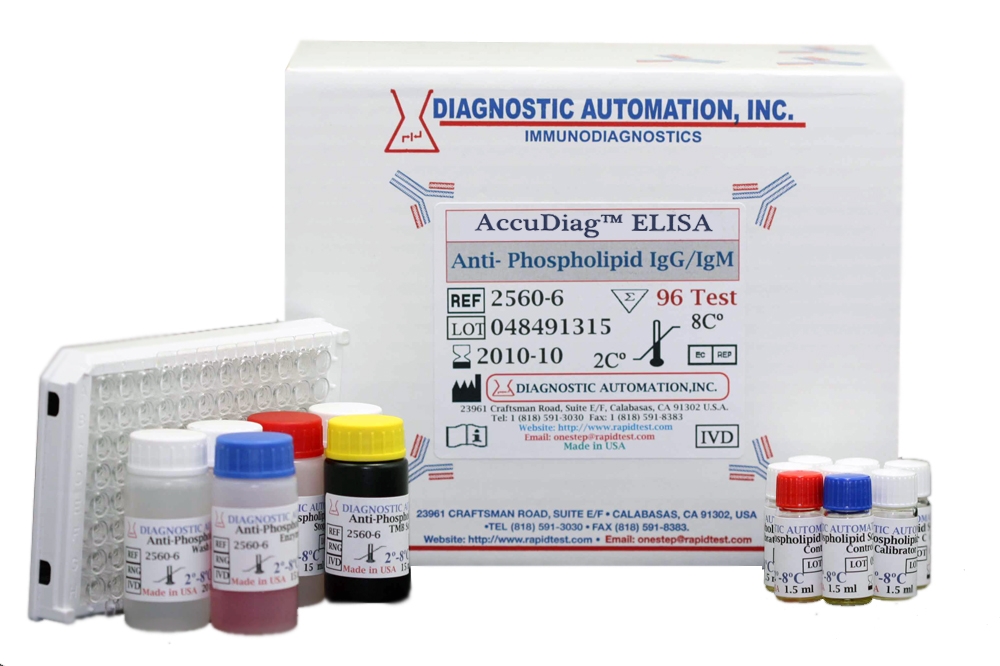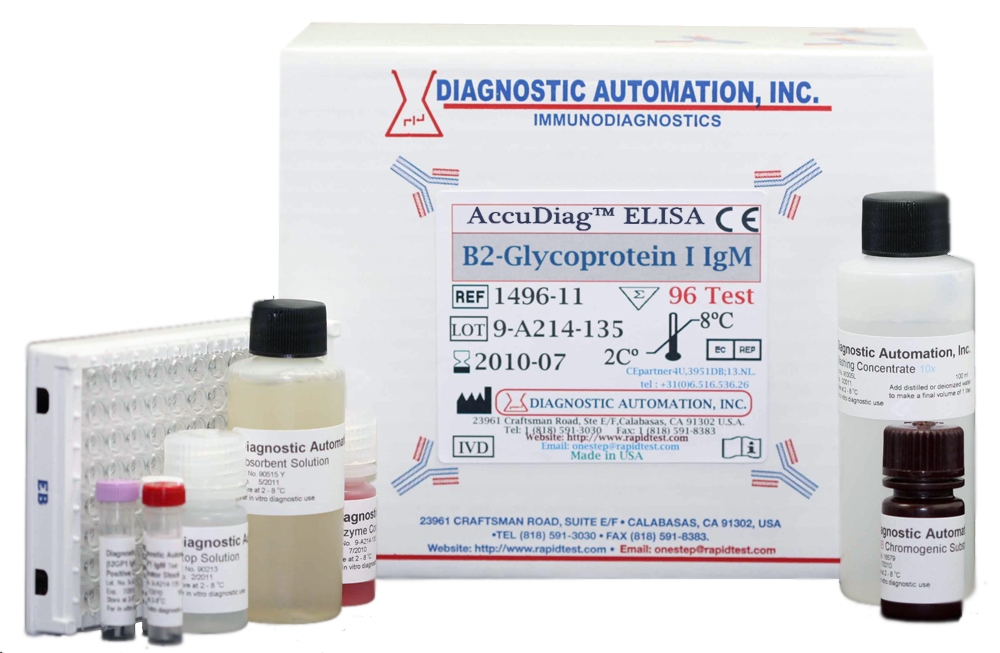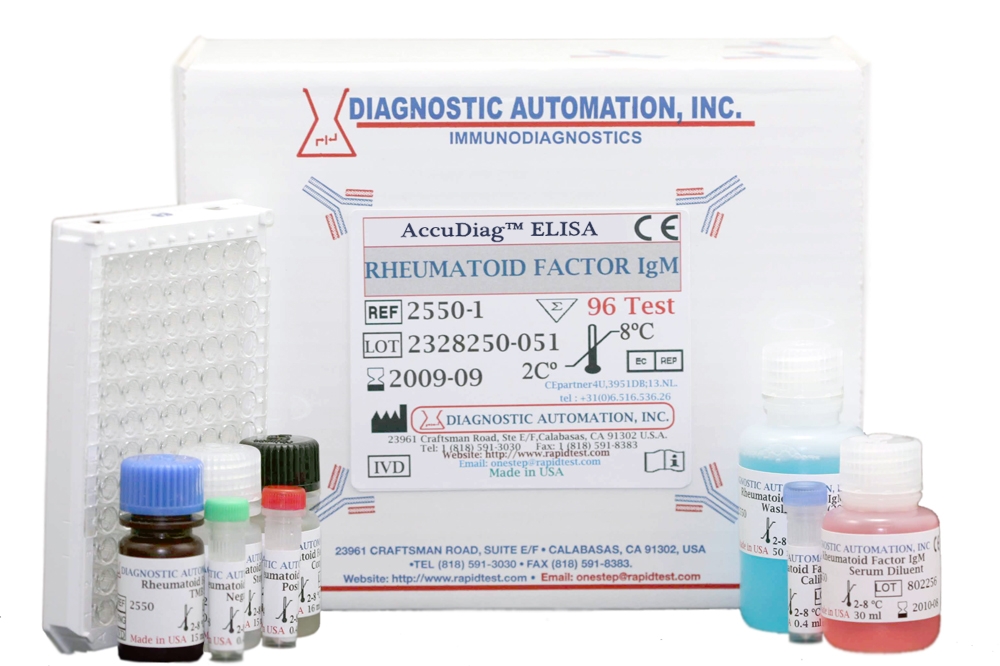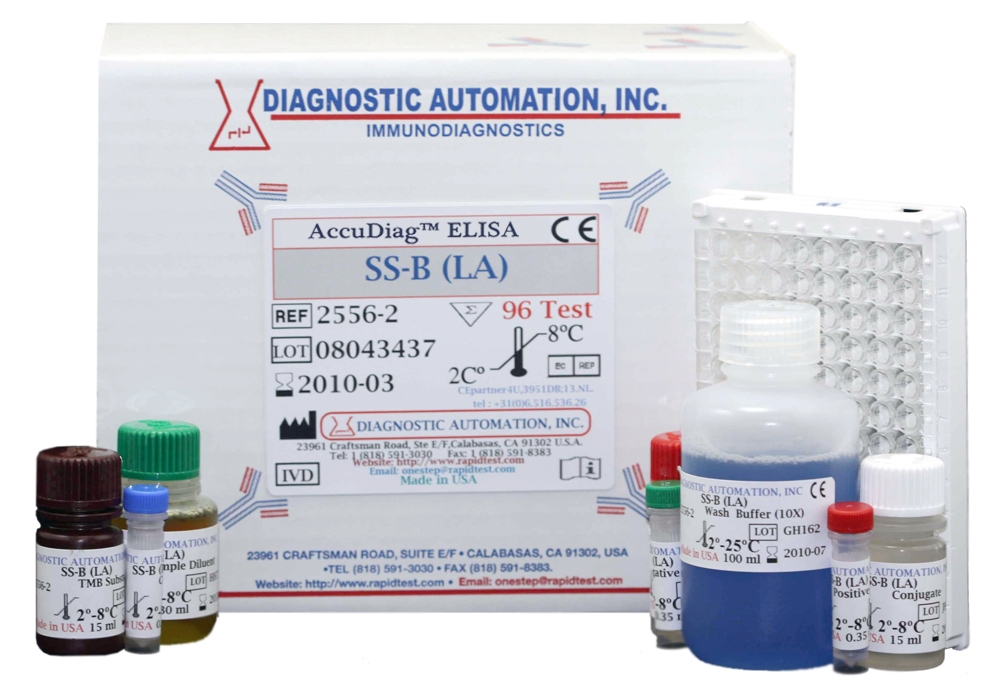








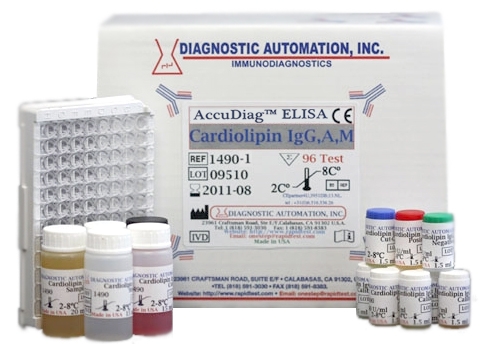
Cardiolipin IgG, A, M ELISA kit
| Name |
Cardiolipin IgG, A, M ELISA Test |
|---|---|
| Full name |
Human Cardiolipin IgG, A, M ELISA Test Kit |
| Category Name | Autoimmune Disease kits |
| Test | 96 |
| Method | ELISA method: Enzyme Linked Immunosorbent Assay |
| Principle | ELISA principle- Peroxidase conjugated |
| Detection Range | Semiquantitative and quantitative |
| Sample | 5 uL serum/plasma |
| Specificity | 98.6% |
| Total Time | ~80 min |
| Shelf Life | 12 Months from the manufacturing date |
 |
 |
 |




Cardiolipin IgG, A, M ELISA kit description:
The Diagnostic Automation Inc. AccuDiag™ Anti-Cardiolipin (IgAGM) ELISA test kit provides a semi-quantitative or quantitative in vitro assay for human autoantibodies of the IgAGM class against cardiolipin in serum or plasma for the diagnosis of anti-phospholipid syndrome (APS).
Material Provided with Cardiolipin IgA, G, M ELISA Kit:
1. Microwell strips: Cardiolipin antigen coated wells
2. Stop Solution: 1M Hydrochloric Acid
3. TMB Substrate
4. Conjugate: IgA/G/M Anti-human immunoglobulins conjugate
5. Calibrator: 6 vials, 0, 3,10,30,100,300 U/ml
6. Cut-off Control: Human serum (diluted)
7. Positive Control: Human serum (diluted)
8. Negative Control: Human serum (diluted)
Materials Required, not Provided:
1. Precision pipettes
2. Distilled or deionized water
3. EIA kit Microplate Washer
4. EIA kit Microplate Reader with a 450 nm filter
Cardiolipin IgA, G, M ELISA Kit Background Information:
Antibodies against cardiolipin belong to the group of anti-phospholipid antibodies specific for negatively charged phospholipids, components of biological membranes.Cardiolipin is an acidic phospholipid derived from glycerol and was named because of its isolation from bovine heart in 1941. Anti-phospholipid antibodies are frequently found in sera of patients with SLE and related diseases. The prevalence of anti-cardiolipin antibodies in SLE is 24-50 %. The occurrence of anti-cardiolipin antibodies in patients with SLE and related diseases is typical for a secondary anti-phospholipid syndrome (APS). In contrast, anti-cardiolipin antibodies in patients with no other autoimmune diseases characterize the primary anti-phospholipide syndrome (APS). Many studies have shown a correlation between these autoantibodies and an enhanced incidence of thrombosis, thrombocytopenia and habitual abortions (as a consequence of placental infarct). The exact mechanism by which pathogenic anti-phospholipid antibodies induce thrombosis is not yet revealed fully. Anti-cardiolipin antibodies mainly recognize specific epitopes on a complex composed out of cardiolipin and Beta2-glycoprotein I which are expressed only when Beta2-glycoprotein I interacts with cardiolipin. The assay is an aid in the diagnosis of SLE, primary and secondary anti-phospholipid syndrome (APS) and should be used in conjunction with other serological tests and clinical findings.
Cardiolipin IgA, G, M ELISA Test Principle:
Serum samples diluted 1:101 are incubated in the microplates coated with the specific antigen. Patient antibodies, if present in the specimen, bind to the antigen.The unbound fraction is washed off in the following step. Afterwards anti-human immunoglobulins conjugated to horseradish peroxidase conjugate are incubated and react with the antigen-antibody complex of the samples in the microplates. After washing and addition of TMB an enzymatic colorimetric (blue) reaction, which is stopped by diluted acid color changes to yellow. For additional details please refer to the instructions for use.
Notable features of Autoimmune Disease ELISA Kits:
User-friendly directions and explanation of test procedures
Simple and safe reagent preparation
Clear instructions on specimen collection
Comprehensive package of required materials
Explicit quality control and storage guidelines
Reliable and easy-to-read test results
Product inserts for all Autoimmune ELISA kits follow a similar method. See the Cardiolipin Cardiolipin IgA, G, M ELISA Kit product insert for specific details on preparation, procedures, quality control, and test result interpretation.
Diagnostic Automation Inc. also provides other Autoimmune Disease ELISA Kits. For more information about ELISA Kits, Rapid Tests, IFA Kits, CLIA Test Kits, or Serology tests, please see our website home page, or contact our Customer Service Representatives at 818-591-3030 .