







Beta 2 Glycoprotein 1 IgA ELISA kit
| Name |
Beta 2 Glycoprotein 1 IgA ELISA Test |
|---|---|
| Full name |
Human Beta 2 Glycoprotein 1 IgA ELISA Test Kit |
| Category Name | Autoimmune Disease kits |
| Test | 96 |
| Method | ELISA method: Enzyme Linked Immunosorbent Assay |
| Principle | ELISA principle- Peroxidase conjugated |
| Detection Range | 6.3-200SGU |
| Sample | 5ul |
| Sensitivity | 99.50% |
| Total Time | ~80 min |
| Shelf Life | 12 months |
 |
 |
 |




Beta 2 Glycoprotein 1 IgA ELISA kit description:
The Diagnostic Automation Beta2GP1 IgA Enzyme-linked Immunosorbent Assay (ELISA) is intended for the detection and semiquantitative determination of IgA antibodies to Beta2GP1 in human sera or plasma. The results of the assay are to be used as an aid in the diagnosis of certain autoimmune disease thrombotic disorders, anti-phospholipid syndrome, SLE or lupus-like disorders.
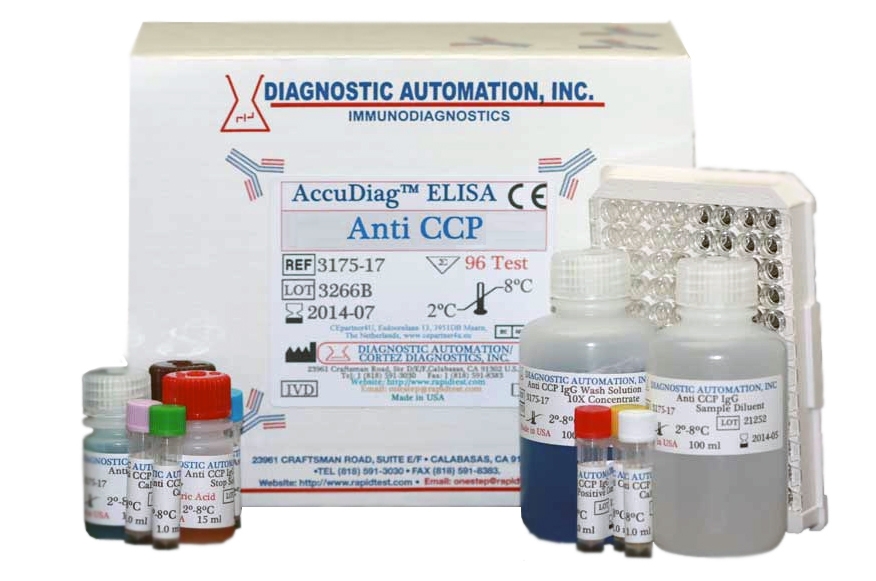
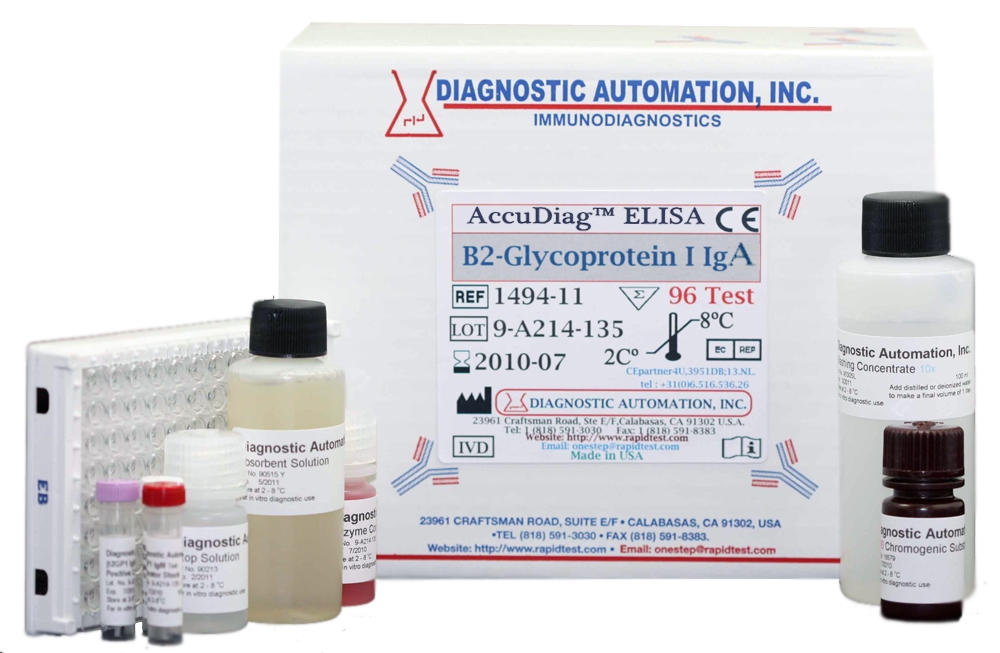
Material Provided with Beta2GP1 IgA ELISA Kit:
1. Microwell strips: Beta2 GP1 antigen coated wells
2. Sample Diluent
3. Washing concentrate 20x
4. TMB Chromogenic Substrate
5. Enzyme conjugate:
6. Calibrator set: 5, 10, 20, 40, 80, 160 SAU
7. Control set: Negative and Positive controls
8. Stop solution
Materials Required, not Provided:
1. Precision pipettes
2. Distilled or deionized water
3. EIA kit Microplate Washer
4. EIA kit Microplate Reader with a 450 nm filter
Beta2GP1 IgA ELISA Kit Background Information:
Cardiolipin autoantibodies (ACA) are described for various autoimmune diseases. The presence of anti-cardiolipin antibodies in SLE can be related to the development of thrombocytopenia, in gynaecology they are supposed to cause intrauterine death or recurrent abortion. Furthermore, anti-cardiolipin antibodies have been found in some nonthrombotic neurological disorders like cerebrovascular insufficiency, cerebral ischemia or chorea and in myocardial infarction. Recent studies have shown that a 50kD serum cofactor is required for anticardiolipin antibodies, to bind to cardiolipin which has been coated onto plastic plates. The cofactor has been identified as Beta2-glycoprotein 1 also termed apolipoprotein H. Beta2GP1 has been known as an in vitro inhibitor of the intrinsic blood coagulation pathway, ADP dependent aggregation, and prothrombinase activity of activated platelets. It has been shown conclusively that Beta2GP1 is indeed the antigen to which many anticardiolipin antibody patients are actually binding and furthermore showed that the phospholipid merely serves to link the Beta2GP1 to the solid phase. Beta2GP1 autoantibodies are found in the immunoglobulin classes IgG, IgM and IgA. The determination of IgM antibodies is a valuable indicator in the diagnosis of beginning autoimmune disease, whereas IgG and/or IgA antibodies will be found in progressive stages of manifested autoimmune disorders. IgA antibodies are often associated with IgG antibodies. The determination of IgA antibodies seems to have a greater validity in thrombosis and fetal loss. Indications for determination of anti Beta2GP1 antibodies are: SLE, Thrombosis, Thrombocytopenia, Cerebral Ischemia, Chorea, Epilepsy, Recurrent Abortion and Intrauterine Death.
Beta2GP1 IgA ELISA Test Principle:
Purified B2GP1 antigens are coated on the surface of microwells. Diluted patient serum or plasma, and calibrators, are added to the wells. The Anti Beta2GP1 specific antibodies, if present, bind to the antigens. All unbound materials are washed away. After adding enzyme conjugate, it binds to the antibody-antigen complex. Excess enzyme conjugate is washed off, and TMB Chromogenic substrate is added. The enzyme conjugate catalytic reaction is stopped at a specific time. The intensity of the color generated is proportional to the amount of IgA specific antibodies in the sample. The results are read by a microwell reader, and compared in a parallel manner with calibrators. For additional details please refer to the instructions for use.
Notable features of Autoimmune Disease ELISA Kits:
User-friendly directions and explanation of test procedures
Simple and safe reagent preparation
Clear instructions on specimen collection
Comprehensive package of required materials
Explicit quality control and storage guidelines
Reliable and easy-to-read test results
Product inserts for all Autoimmune ELISA kits follow a similar method. See the Beta2GP1 IgA ELISA Kit product insert for specific details on preparation, procedures, quality control, and test result interpretation.
Diagnostic Automation Inc. also provides other Autoimmune Disease ELISA Kits. For more information about ELISA Kits, Rapid Tests, IFA Kits, CLIA Test Kits, or Serology tests, please see our website home page, or contact our Customer Service Representatives at 818-591-3030 .