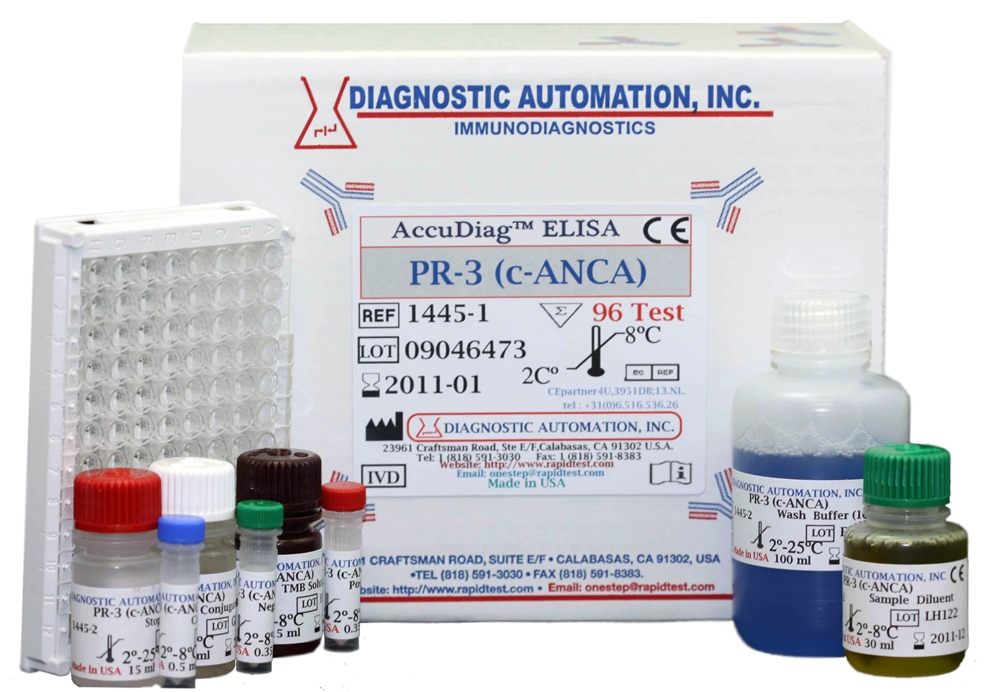








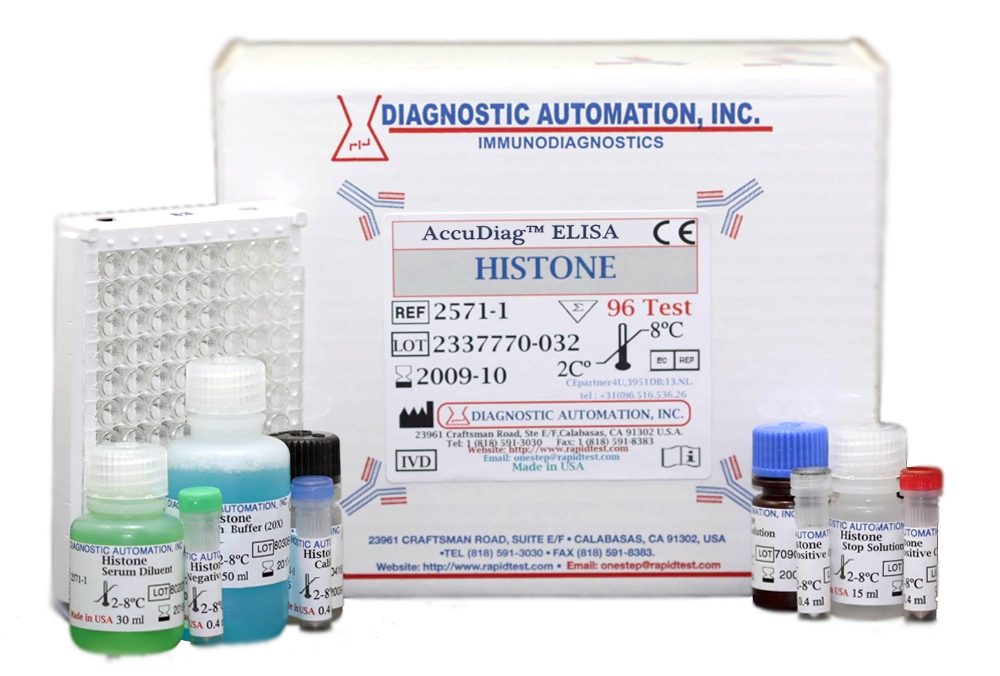
Histone ELISA Kit
| Name |
Histone ELISA Test |
|---|---|
| Full name |
Human Histone ELISA Test Kit |
| Category Name | Autoimmune Disease kits |
| Test | 96 |
| Method | ELISA method: Enzyme Linked Immunosorbent Assay |
| Principle | ELISA - Indirect; Antigen Coated Plate |
| Detection Range | Semi-Quantitative Elisa assay: Positive, low positive, negative, cut off |
| Sample | 10ul |
| Specificity | 90.90% |
| Sensitivity | 98.80% |
| Total Time | ~75min |
| Shelf Life | 12 Months from the manufacturing date |
 |
 |
 |




Histone ELISA Kit description:


The Diagnostic Automation Histone Elisa kit is intended for the detection and semi-quantitation of antibodies to histone in human sera. The assay is to be used to detect antibodies in a single serum specimen. The results of the assay are to be used as an aid to the diagnosis of autoimmune disease.
Materials Provided with Histone ELISA Kit:
1. Histone antigen coated microassay plate: 96 Test, one plate
2. Serum Diluent Type III: Ready to use
3. High Positive Control: Human serum or defibrinated plasma
4. Calibrator: Human serum or defibrinated plasma
5. Negative Control: Human serum or defibrinated plasma
6. Low Positive Control: Human serum or defibrinated plasma
7. HRP Conjugate: Ready to use, Goat antihuman IgG, IgA, and IgM
8. Wash Buffer Type II, 20X
9. Chromogen/Substrate Solution Type I, TMB
10. Stop Solution: Ready to use, contains a 1N H2SO4
Materials & Instrumentations required but not included:
1. Precision pipettes
2. Distilled or deionized water
3. ELISA kit Microplate Washer
4. ELISA kit Microplate Reader at 450nm wavelength
Histone ELISA Kit Background Information:
Systemic autoimmune disease is characterized by the presence of circulating auto antibodies directed to wide variety of cellular antigens. Systemic lupus erythematosis (SLE), commonly referred to as Lupus is best known of these diseases. Other possible connective tissue diseases include mixed connective tissue disease (MCTD), Sjogren syndrome, sclerodema, and polymyositis/dermatomyositis. The majority can be diagnosed by clinical presentation and their antibody profiles to the various antigens involved, which include dsDNA, Sm, RNP, Ro, La, Scl-70, Jo-1, and Histones. Therefore, immunoassays for auto antibodies are useful for diagnostic and prognostic evaluations of autoimmune disease. Histones are a group of small basic proteins that are complexed with DNA. Antibodies to histone are present in approximately 90% of patients with drug induced lupus (DIL). They are also present in approximately 30% of patients with idiopathic lupus (SLE). Patients with DIL usually have antibody to just histone, while SLE patients usually have antibodies to DNA or a variety of ENA.
Classically, antibodies to autoimmune antigens are detected by double imunodiffusion. However, the test is lengthy and suffers weak sensitivity. Enzyme- Linked Immunosorbent Assays (Elisa) combine greater sensitivity with ease of use. Many Elisa have been developed and validated for detecting auto antibodies to various antigens.
Histone ELISA Test Principle:
The DAI Histone test is an Elisa to detect IgG, IgA, and IgM antibodies to histone antigens. Purified histone antigens are attached to a solid phase micro assay well. ELISA rely on the ability of biological materials (i.e., antigens) to adsorb to plastic surfaces. When antigens bound to the solid phase are brought into contact with a patient serum, antigen specific antibody, if present, will bind to the antigen on the solid phase forming antigen- antibody complexes. Excess antibody is removed by washing. This is followed by the addition of goat anti-human IgG, A, M conjugated with horseradish peroxidase which then binds to the antibody-antigen complexes.
Notable features of the Autoimmune Disease ELISA Kits:
User-friendly directions and explanation of test procedures
Simple and safe reagent preparation
Clear instructions on specimen collection
Comprehensive package of required materials
Explicit quality control and storage guidelines
Reliable and easy-to-read test results
Product inserts for most Autoimmune Disease ELISA kits follow a similar method. See the Histone ELISA Kit product insert for details on preparation, procedures, quality control, and test result interpretation.
For more information about ELISA Kits, Rapid Tests, IFA Kits, CLIA Test Kits, or Serology tests, please see our website home page, or contact our Customer Service Representative at 818-591-3030.