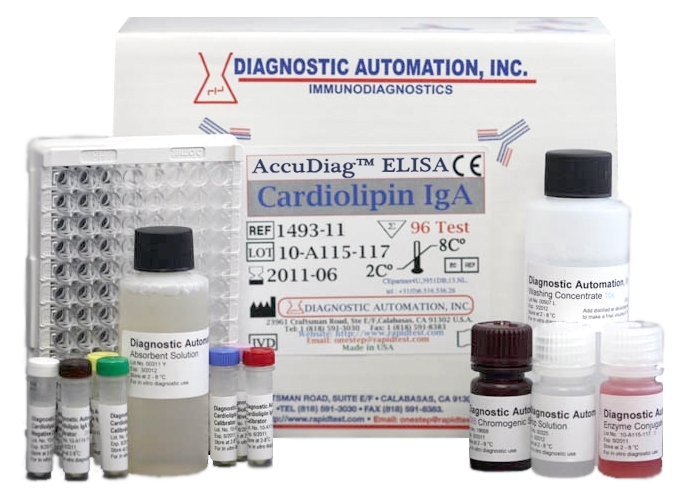
| Name | ENA Combined Screen ELISA test kit |
|---|---|
| Category Name | Autoimmune Disease kits |
| Test | 96 |
| Method | ELISA method: Enzyme Linked Immunosorbent Assay |
| Principle | ELISA principle- Peroxidase conjugated |
| Detection Range | Qualitative - Positive, Negative and Cut-off |
| Sample | 10µl serum |
| Specificity | 100% |
| Sensitivity | 96% |
| Total Time | ~60 min |
| Shelf Life | 12- 14 months |
![]() |
|
![]() |
The Diagnostic Automation ENA Combined Screen Enzyme-Linked Immunosorbent Assay (ELISA) is intended for the detection of antibodies to Sm, RNP, Ro, La, Scl-70, and Jo-1 in human sera. The assay is to be used to detect antibodies in a single serum specimen. The results of the assay are to be used as an aid to the diagnosis of systemic lupus erythem atosis, mixed connective tissue disease, Sjogren syndrome, scleroderma, polymyositis, and dermatomyositis. This apparatus is for in vitrodiagnostic use which is a high complexity kind of test.
Systematic autoimmune disease is characterized by the presence of circulating autoantibodies directed to a wide variety of cellular antigens. Systemic lupus erythematosis (SLE), commonly referred to as Lupus, is the best known of these diseases. Other possible connective tissue diseases include mixed connective tissue disease (MCTD), Sjogren syndrome, sclerodema, and polymyositis/dermatomyositis. The majority can be diagnosed by clinical presentation and their antibody profiles to the various antigens involved, which include dsDNA, Sm, RNP, Ro, La, Scl-70, Jo-1, and Histones. Therefore, immunoassays for autoantibodies are useful for diagnostic and prognostic evaluations of autoimmune disease. The Sm (Smith) antigen is composed of nuclear RNA and several polypeptides. Antibodies to Sm are present in approximately 30% of patients with SLE. Sm is a very specific marker for SLE. Sm antibodies are very rare in other autoimmune diseases and normal.
RNP antigen is composed of RNA and several protein components. The antigen is closely associated with Sm antigen. Approximately 45% of patients with SLE have antibodies to RNP. RNP antibodies are also found in patients with discoid lupus, Sjogren syndrome, scleroderma, rheumatoid arthritis and MCTD. Very high titer to RNP is a characteristic of MCTD. Ro (SS-A) antigen consists of protein complex with RNA. Approximately 60% of patients with Sjogren syndrome and 35% of SLE patients have antibodies of Ro. SLE patients with Ro antibodies alone (negative La/SSB) have a greater chance of developing nephritis. La (SS-B) antigen consists of a protein complexed to RNAs. There are approximately 60% of patients with Sjogren syndrome and 15% of SLE patients have antibody to La. Ro (SSA) antibody occurs in virtually all sera with La antibody. However, some SLE patients have Ro only antibody profiles. Scl-70 antigen is a nuclear enzyme topoisomerase 1. Approximately 20-30% of patients with scleroderma have antibodies to Scl-70. The antibody is rarely seen in other conditions. Scl-70 antibodies are usually present in the diffuse subtype of scleroderma while antibodies to centromere proteins are dominant in the limited subtype of scleroderma or CREST syndrome. Jo-1 antigen is the cellular enzyme histidyl-tRNA synthetase. Approximately 30% of patients with polymyositis (PM) and 10% of patients with dermatomyositis (DM) have antibodies to Jo-1. Antibodies to Jo-1 are seen rarely in normal and other diseases except for those which overlap with PM-DM. Classically, antibodies to autoimmune antigens are detected by double immunodiffusion. However, ENA Combined Screen ELISA kit is lengthy and suffers weak sensitivity. Enzyme-Linked Immunosorbent Assays (ELISAs) combine greater sensitivity with ease of use. Many ELISAs have been developed and validated for detecting autoantibodies to various antigens.
There are limitations of use of ENA Combined Screen ELISA kit: (1) the result of the assay should not be interpreted as being diagnostic. The results should only be used as an aid to diagnosis. The results should be interpreted in conjunction with the clinical evaluation of the patient. (2) Sera from patients with other autoimmune diseases and from normal individuals may contain autoantibodies. (3) The assay should be used only with serum. Icteric, lipemic, hemolyzed and heat inactivated serum should be avoided. (4) Index Values of â?¥ 10.00 should be reported as greater than 10.