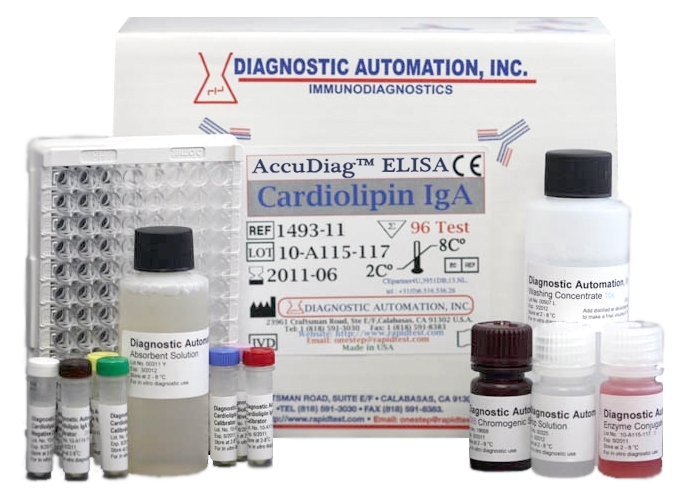
Name

Sm/RNP ELISA test kit

Category Name Autoimmune Disease kits
Test 96
Method ELISA method: Enzyme Linked Immunosorbent Assay
Principle ELISA principle- Peroxidase conjugated
Detection Range Qualitative elisa assay- Positive, Negative and Cut-off
Sample 10µl serum
Specificity 99%
Sensitivity 100%
Total Time ~60 min
Shelf Life 12- 14 months

Item #:                    2558-2Z   Quantity:               

Sm-RNP-ELISA-Kit.pdf
 

Sm/RNP ELISA test kit


Description:


The Diagnostic Automation Sm/RNP Enzyme- Linked Immunosorbent Assay (ELISA) is intended for the detection and semi-quantization of antibodies to Sm/RNP complex in human sera. The assay is to be used to detect antibodies in a single serum specimen. The results of the assay are to be used as an aid to the diagnosis of autoimmune disease. This is a high complexity test for in vitro diagnostic use.


The Diagnostic Automation Sm/RNP test is an Enzyme-Linked Immunosorbent Assay to detect IgG, IgA, and IgM antibodies to Sm/RNP antigens. Sm/RNP antigens are attached to a solid phase microassay well. Enzyme-Linked Immunosorbent Assays (ELISA) relies on the ability of biological materials (i.e., antigens) to adsorb to plastic surfaces such as polystyrene (solid phase). When antigens bound to the solid phase are brought into contact with a patient's serum, antigen specific antibody, if present, will bind to the antigen on the solid phase forming antigen- antibody complexes. Excess antibody is removed by washing. This is followed by the addition of goat anti-human IgG, IgA, IgM conjugated with horseradish peroxidase which then binds to the antibody-antigen complexes. The excess conjugate is removed by washing, followed by the addition of Chromogen/Substrate, tetramethylbenzidine (TMB). If specific antibody to the antigen is present in the patient's serum, a blue color develops. When the enzymatic reaction is stopped with 1N H2SO4, the contents of the wells turn yellow. The color, which is indicative of the concentration of antibody in the serum, can be read on a suitable spectrophotometer or ELISA microwell plate reader.


Precautions in using this test are present such as: (1) for in vitro diagnostic use. (2) The human serum components used in the preparation of the Controls and Calibrator in this kit DAI Code # 1 4 have been tested by an FDA approved method for the presence of antibodies to human immunodeficiency virus 1 & 2 (HIV 1&2), hepatitis C (HCV) as well as hepatitis B surface antigen and found negative. Because no test method can offer complete assurance that HIV, HCV, hepatitis B virus, or other infectious agents are absent, specimens and human-based reagents should be handled as if capable of transmitting infectious agents. (3) The Centers for Disease Control & Prevention and the National Institutes of Health recommend that potentially infectious agents be handled at the Biosafety Level 2 (8). (4) The components in this kit have been quality control tested as a Master Lot unit. Do not mix components from different lot numbers except Chromogen/Substrate Solution Type I, Stop Solution, Wash Buffer Type II, and Serum Diluent Type III. Do not mix with components from other manufacturers. (5) Do not use reagents beyond the stated expiration date marked on the package label. (6) All reagents must be at room temperature (21°to 25°C) before running assay. Remove only the volume of reagents that is needed. Do not pour reagents back into vials as reagent contamination may occur. (7) Before opening Control and Calibrator vials, tap firmly on the bench top to ensure that all liquid is at the bottom of the vial. (8) Use only distilled or deionized water and clean glassware. (9) Do not let wells dry during assay; add reagents immediately after completing wash steps. (10) Avoid cross-contamination of reagents. Avoid splashing or generation of aerosols. Wash hands before and after handling reagents. Cross-contamination of reagents and/or samples could cause erroneous results. (11) If washing steps are performed manually, wells are to be washed three times. Up to five wash cycles may be necessary if washing manifold or automated equipment is used. (12) Sodium azide inhibits Conjugate activity. Clean pipette tips must be used for the Conjugate addition so that sodium azide is not carried over from other reagents. (13) Certain reagents in this kit contain sodium azide for use as a preservative. It has been reported that sodium azide may react with lead and copper in plumbing to form explosive compounds. When disposing, flush drains with water to minimize build-up of metal azide compounds. (14) Never pipette by mouth or allow reagents or patient sample to come into contact with skin. Reagents containing proclin, sodium azide, and TMB may be irritating. Avoid contact with skin and eyes. In case of contact, immediately flush area with copious amounts of water. (15) If a sodium hypochlorite (bleach) solution is being used as a disinfectant, do not expose to work area during actual test procedure because of potential interference with enzyme activity. (16) Avoid contact of Stop Solution (1N sulfuric acid) with skin or eyes. If contact occurs, immediately flush area with copious amounts of water. (17) Caution: Liquid waste at acid pH must be neutralized prior to adding sodium hypochlorite (bleach) solution to avoid formation of poisonous gas. Recommend disposing of reacted, stopped plates in biohazard bags. See Precaution 3. (18) Do not use Chromogen/Substrate Solution if it has begun to turn blue. (19) The concentrations of anti-Sm/RNP in a given specimen determined with assays from different manufacturers can vary due to differences in assay methods and reagent specificity.

realx'  
Thyroid Elisa Kit
Categories Banner
Email Rapidtest
Order Elisa Kits
Order Elisa Kits