







Chlamydia Trachomatis IgM ELISA Kit
| Name |
Chlamydia Trachomatis IgM ELISA Test |
|---|---|
| Full name |
Human Chlamydia Trachomatis IgM ELISA Test Kit, Research and Export use only |
| Category Name | Infectious Disease ELISA kits |
| Test | 96 |
| Method | ELISA: Enzyme Linked Immunosorbent Assay |
| Principle | ELISA - Indirect; Antigen Coated Plate |
| Detection Range | Qualitative Positive; Negative control & Cut off |
| Sample | 5ul Serum |
| Specificity | 99% |
| Sensitivity | 99% |
| Total Time | ~75 min |
| Shelf Life | 12 Months from the manufacturing date |
 |
 |
 |




Chlamydia Trachomatis IgM ELISA Kit description:
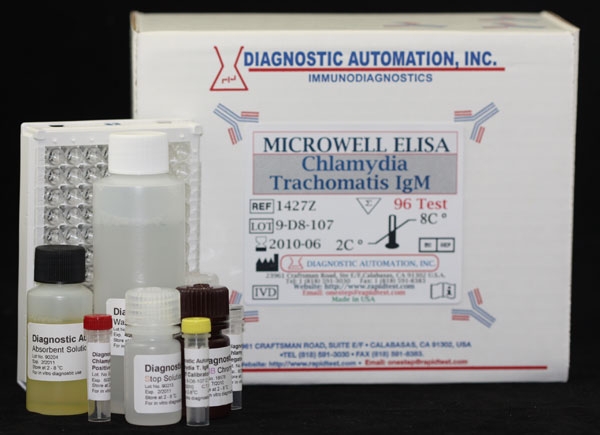
The Diagnostic Automation Chlamydia Trachomatis IgM ELISA kit is intended for the determination of specific IgM antibody to Chlamydia in a single human serum sample, by an Enzyme-Linked Immunosorbent Assay.
Materials provided with the Chlamydia Trachomatis IgM ELISA test kit:
1. Microwell Stips 12 x 8 Chlamydia trachomatis antigen coated wells
2. Absorbent Solution
3. Calibrator
4. Negative Control
5. Positive Control
6. Washing Concentrate 20X
7. Enzyme Conjugate
8. TMB Chromogenic Substrate
9. Stop Solution
Materials & Instrumentations Required, not provided:
1. Freshly distilled or deionized water
2. Dispensing system and/or pipette & tips
3. Dry incubator or water bath
4. Microshaker for mixing
5. EIA kit Microplate Washer
6. EIA kit Microplate Reader at 450nm wavelength
Chlamydia Trachomatis IgM ELISA Test Background Information
Chlamydia Trachomatis is one of the most common human pathogens. Of the 15 recognized serotypes, 4 (A, B, Ba, and C) have been shown to cause hyperendemic blinding trachoma, a disease which afflicts hundreds of millions of people in developing countries. Three serotypes (L-1, L-2, and L-3) are the causes of lymphogranuloma venereum (LGV), a sexually transmitted systemic disease. The other serotypes (D through K) have been associated with genital tract infections and sporadic cases of conjunctivitis in industrialized societies. These agents are the major recognized cause of nongonococcal urethritis in men, in whom they may also cause epididymitis. In women, C. trachomatis causes cervicitis and has been associated with acute salpingitis. Infants born through an infected birth canal may contract the infection and then develop inclusion conjunctivitis of the newborn and/or the characteristic chlamydial pneumonia syndrome. High levels of anti-Chlamydia IgG antibody are of diagnostic value in chronic or systemic infections such as salpingitis, mechanical infertility, perihepatitis, epididymitis, Reiter syndrome and pneumonitis. Diagnostic Automation Chlamydia Trachomatis IgM ELISA kit employs the LGV type 2 broadly reacting antigen of Chlamydia Trachomatis. It will detect Chlamydia Trachomatis, Chlamydia Psittaci and Chlamydia Pneumoniae (TWAR) antibodies.
Chlamydia Trachomatis IgM ELISA kit Precision:
The precision of the assay was evaluated by testing three different sera eight replicates on 3 days. The intra-assay and inter-assay C.V. are summarized in the enclosed Package Insert. A serum specimen taken in an early stage during acute phase of infection may contain low levels of IgM antibody and render an IgM Index result negative. As with other serological assays, the results of these assays should be used in conjunction with information available from clinical evaluation and other diagnostic procedures.
Diagnostic Automation Chlamydia Trachomatis IgM ELISA kit provides all the necessary reagents for the rapid qualitative determination of Chlamydia Trachomatis IgM antibody in human sera.
For more information about ELISA Kits, Rapid Tests, IFA Kits, CLIA Test Kits, or Serology tests, please see our website home page, or contact our Customer Service Representatives at 818-591-3030.