








HBsAg ELISA Kit
| Name |
HBsAg ELISA Test |
|---|---|
| Full name |
Human Hepatitis B Virus Surface Antigen ELISA Test Kit, Export Use Only |
| Category Name | Infectious Disease ELISA kits |
| Test | 96,192,480 |
| Method | ELISA method: Enzyme Linked Immunosorbent Assay |
| Principle | Indirect ELISA: Antigen Coated Plate |
| Detection Range | Qualitative: Positive & Negative Control |
| Sample | 50ul |
| Total Time | ~ 70 min |
| Shelf Life | 12 Months from the manufacturing date |
 |
 |
 |




HBsAg ELISA Kit description:
"Export Use Only"
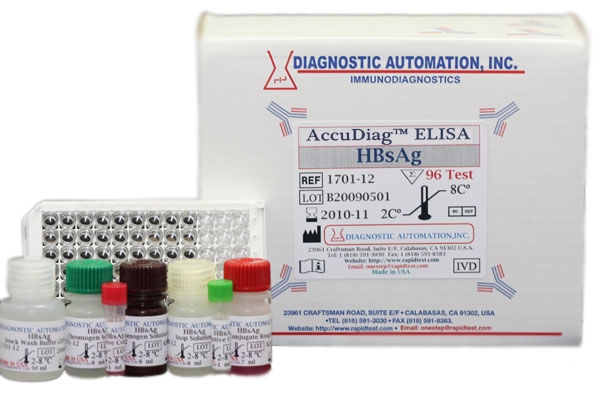
Diagnostic Automation Inc. offers an HBsAg ELISA kit, which is an enzyme-linked immunosorbent assay for the qualitative detection of HBsAg in human serum or plasma. The HBsAg ELISA Kit is designed as an aid in screening blood donors, and an aid in the diagnosis of clinical conditions related to hepatitis B-infected individuals.
Materials Provided with HBsAg ELISA Assay Kit:
1. Microwell strips: wells contain monoclonal antibodies reactive to HBsAg (anti-HBs)
2. HBsAg EIA test Negative Control, non-reactive for HBsAg
3. HBsAg EIA test Positive Control (HBsAg)
4. HRP-Conjugate Reagent HBsAg elisa test: HRP- anti-HBs antibodies
5. HBsAg elisa test Stock Wash Buffer 20x
6. Chromogen Solution A: urea peroxide
7. Chromogen Solution B: TMB solution
8. Stop Solution
9. Plastic sealable Bag, 1unit
10. Cardboard Plate Cover, 2sheets
11. Package Inserts
Materials & Instrumentations Required not provided:
1. Freshly distilled or deionized water
2. Dispensing system and/or pipette & tips
3. EIA kit Microplate Washer
4. EIA kit Microplate Reader, single wavelength 450nm or
dual wavelength 450nm & 630nm
HBsAg ELISA Kit Background Information
Hepatitis B infection is spread through infected blood or body secretions of infected individuals. Since Hepatitis B virus (HBV) is known as one of the major causes of blood transmitted hepatitis infections, blood screening using the HBsAg ELISA test is one of the most effective ways of preventing the spread of HBV. When using this kit, it is important to classify hepatitis B infection through three phases of the infection - incubation, acute, and convalescent. This can be done by identifying serological markers through each phase. Knowing the serological markers of HBsAg is an excellent method for the diagnosis and treatment of infected individuals. Symptoms of HBV infection can range from mild to severe, including chronic liver disease (cirrhosis and carcinoma). HBV is an enveloped, double-stranded DNA virus belonging to the Hepadnaviridae family. The outer envelope surface antigen of the Hepatitis B virus is HBsAg. It contains the determinant "a" and is identified in two subgroups (ay and ad). HBV has four HBsAg subtypes (adw, ady, ayw, and ayr) and has 10 major serotypes. HBsAg can be identified two to four weeks before the ALT levels are abnormal, and three to five weeks before symptoms appear. HBsAg elisa assay is one of the best methods available for either screening blood donors or in the clinical diagnosis of hepatitis B-infected individuals.
HBsAg ELISA Assay Kit Principle
The HBsAg ELISA Test kit employs an antibody sandwich ELISA technique where monoclonal antibodies unique to HBsAg, are pre-coated on polystyrene microwell strips. The serum or plasma sample is added together with a second antibody, the HRP Conjugate, (horseradish peroxidase) and directed against a different epitope of HBsAg. Throughout the time of incubation, specific immunocomplex that may have formed (indicating presence of HBsAg) is captured on the solid phase. After washing, to eliminate serum proteins and unbound HRP-conjugate, chromogen solutions containing tetramethyl-benzidine (TMB) and urea peroxide are added to the wells. Next, the colorless chromogens are hydrolyzed by the bound HRP-conjugate to a blue-colored product while in the presence of the antibody-antigen-antibody (HRP) sandwich immunocomplex. Halting the reaction with sulfuric acid, the blue color then turns yellow. The color intensity can be gauged proportionally to the amount of antigen captured in the wells, and to the amount in the sample, respectively. The wells remain colorless if the HBsAg result is negative.
HBsAg ELISA Test Results Interpretations
(S = the individual optical density (OD) of each specimen)
Negative Results (S/C.O. <1): samples giving an optical density less than the
Cut-off value are considered negative, which indicates that no hepatitis B virus
surface antigen has been detected with this HBsAg ELISA, therefore the patient
is probably not infected with hepatitis B virus.
Positive Results (S/C.O.>1): samples giving an optical density greater than or
equal to the Cut-off value are considered initially reactive, which indicates that
HBV surfaces antigen has probably been detected with this HBsAg ELISA .
For additional details please refer to the instructions for use.
HBsAg ELISA Assay Performance Characteristics
Analytical Specificity
1. No cross reactivity observed with samples from patients infected with HAV,
HCV, HIV, CMV, and TP
2. No interference from rheumatoid factors up to 2000U/ml observed
3. No high dose hook effect up to HBsAg concentrations of 200000ng/ml
observed during clinical testing
HBsAg ELISA Assay Related kits:
HBsAg Rapid Test Kit
http://www.rapidtest.com/index.php?i=HBsAg-Rapid-Test&id=352&cat=30
Diagnostic Automation offers other test kits:
http://www.rapidtest.com/
For more information about ELISA Kits, Rapid Tests, IFA Kits, CLIA Test Kits, or Serology tests, please see our website home page, or contact our Customer Service Representative at 818-591-3030.
* Not to be sold, shipped or distributed in The United States.
HBsAg elisa kit
In recent study, four methods, chemiluminescent microparticle immunoassay (CMIA), electrochemiluminescent immunoassay (ECLIA), enzyme-linked immunosorbent assay (ELISA) and golden immunochromato-graphic assay (GICA) were applied to test the HBsAg level. Evaluation of the four methods in qualitative diagnosis of HBsAg in 116,455 specimens showed no significant discrepancy among four methods tested and ELISA kit was identified to be suitable for the qualitative diagnosis of HBsAg.
Ref: Liu et al., J Virol Methods, Feb 2014.
Searchable names for HBsAg elisa kit:anti-HBsAg; Buy HBsAg elisa kit; Hepatitis B Surface Antigen (HBsAg), ELISA Kit 1701-12 datasheet at Diagnostic Automation; anti-HBsAg; HBsAg; anti-Hepatitis B Surface Antigen (HBsAg); Hepatitis B Surface Antigen (HBsAg) ELISA Kit; hepatitis B surface antigen; ELISA Kit for Infectious Disease; HBsAg elisa kit; anti-HBsAg.