







Bordetella Pertussis IgA ELISA kit
| Name |
Bordetella Pertussis IgA ELISA Test |
|---|---|
| Full name |
Human Bordetella Pertussis IgA ELISA Test Kit |
| Category Name | Infectious Disease ELISA kits |
| Test | 96 |
| Method | ELISA method: Enzyme Linked Immunosorbent Assay |
| Principle | ELISA - Indirect; Antigen Coated Plate |
| Detection Range | Quantitative Positive; Weak Positive; Negative control |
| Sample | 5 ul serum/plasma |
| Specificity | 92% |
| Sensitivity | 94% |
| Total Time | ~ 110min |
| Shelf Life | 12 Months from the manufacturing date |
 |
 |
 |




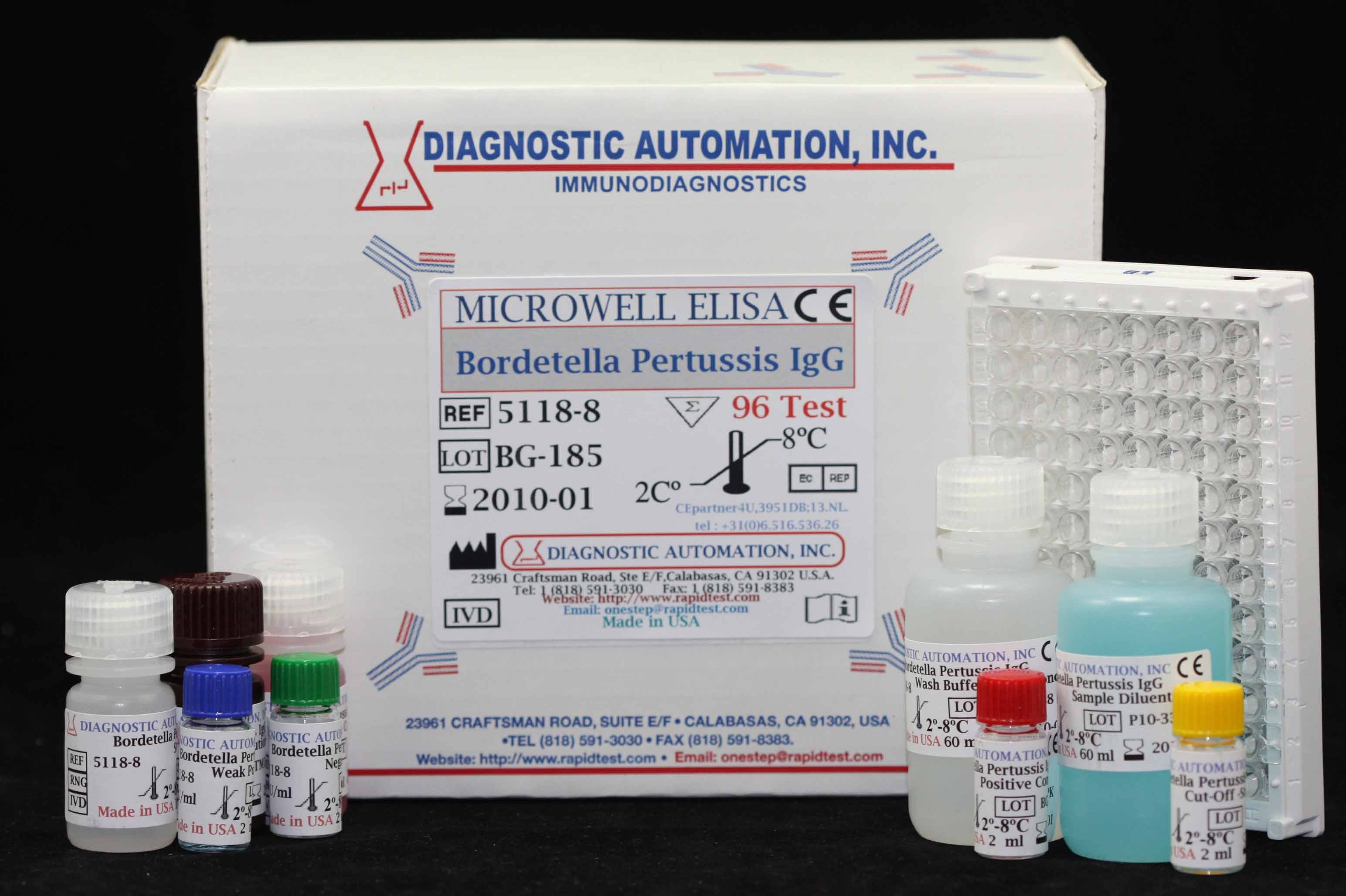
Bordetella Pertussis IgA ELISA kit description:

The Diagnostic Automation Bordetella pertussis IgA Antibody ELISA Test Kit has been designed for the detection and the quantitative determination of specific IgA antibodies against Bordetella pertussis in serum and plasma. Further applications in other body fluids are possible and can be requested from the Technical Service of Diagnostic Automation Inc.
Material Provided with Bordetella Pertussis IgA ELISA Kit:
1.Microtiter Strips:wells coated with a Bordetella pertussis antigen (serotype 1,2,3)
2.Bordetella Pertussis IgA EIA kit Calibrator A (Negative Control)
3.Calibrator B (Cut-Off Standard)
4.Bordetella Pertussis IgA ELISA Test Calibrator C (Weak Positive Control)
5.Calibrator D (Positive Control)
6.Enzyme Conjugate: anti-human-IgA-HRP (rabbit)
7.Bordetella Pertussis IgA Test Substrate:TMB
8.Stop Solution:0.5 M sulfuric acid
9.Sample Diluent: PBS/BSA buffer
10.Bordetella Pertussis EIA Kit Washing Buffer: PBS + Tween 20, 10x
11.Plastic Foils
12.Plastic Bag
Materials Required, not Provided:
1. Precision pipettes
2. Distilled or deionized water
3. EIA kit Microplate Washer
4. EIA kit Microplate Reader with a 450 nm
Bordetella Pertussis IgA ELISA Kit Background Information:
Whooping cough is a disease of the respiratory tracts which is caused by Bordetella pertussis bacteria. It is transmitted by airborne infection. The gramnegative Coccobacillus produces a series of biologically active molecules. The different compounds appear either during the pathogenesis or during the process of immunization against pertussis and show different effects. A characterisation has been made for the pertussis toxin (pt), the filamentery haemagglutinine (fha) and different lipopolysaccharides (lps). Pertussis shows a high rate of transmission and can cause severe diseases, especially for very young children. The serological response following pertussis disease or immunization with pertussis vaccine has been measured with agglutination assays, precipitins, complement fixation and ELISA assays, in which Bordetella antigen (containing toxin, FHA and LPS and standardized in U/ml) is bound to a solid phase support, are sensitive, easy to perform and can be used both to determine seropositivity with a single serum and to indicate recent Bordetella infection by determination of IgM and IgA.
Bordetella Pertussis IgA ELISA Test Principle:
The Diagnostic Automation Bordetella pertussis IgA antibody test kit is based on the principle of the enzyme immunoassay (EIA). Bordetella antigen is bound on the surface of the microtiter strips. Diluted patient serum or standards are pipetted into the wells. A binding between the IgA antibodies of the serum and the immobilized Bordetella antigen takes place. For additional details please refer to the instructions for use.
Diagnostic Automation Inc. also provides other Infectious Disease ELISA Kits. For more information about ELISA Kits, Rapid Tests, IFA Kits, CLIA Test Kits, or Serology tests, please see our website home page, or contact our Customer Service Representatives at 818-591-3030 .