







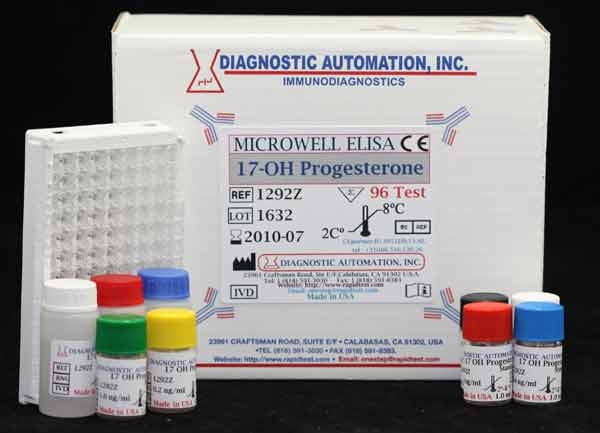
17-alpha hydroxy Progesterone ELISA kit
| Name |
17-alpha hydroxy Progesterone ELISA Test |
|---|---|
| Full name |
Human 17-alpha hydroxy Progesterone ELISA Test Kit |
| Category Name | Steroid ELISA kits |
| Test | 96 |
| Method | ELISA method: Enzyme Linked Immunosorbent Assay |
| Principle | Competitive Enzyme Immunoassay |
| Detection Range | 0-19.2 ng/mL |
| Sample | 25 ul Serum |
| Specificity | 100% |
| Sensitivity | 0.5ng/mL |
| Total Time | ~75 min |
| Shelf Life | 12 Months from the manufacturing date |
 |
 |
 |




17-alpha hydroxy Progesterone ELISA kit description:

The Diagnostic Automation 17- a OH Progesterone EIA test kit is a Competitive immunoenzymatic colorimetric method for quantitative determination of 17a OH Progesterone concentration in human serum and plasma.
Material Provided with 17- a OH Progesterone ELISA Kit:
1. Microplate: Coated with anti 17 OH progesterone antibody
2. TMB-substrate
3. Stop solution
4. 17 a OH Progesterone EIA Kit Standards: STD0-STD5
5. 17 a OH Progesterone EIA Test Control
6. 17 a OH Progesterone ELISA Test Conjugate
7. Wash Solution 10X
Materials Required, not Provided:
1. Precision pipettes
2. Distilled or deionized water
3. EIA kit Microplate Washer
4. EIA kit Microplate Reader with a 450 nm
HGH ELISA Kit Background Information:
17-Hydroxyprogesterone (17-OH progesterone or 17OHP) is a C-21 steroid hormone produced in the adrenal gland and gonads, during the synthesis of glucocorticoids and sex steroids. 17OH progesterone is a precursor of cortisol that accumulates in the case of adrenal 21-hydroxylase deficiency and decreased after replacement therapy with cortisol. High values are found in congenital adrenal hyperplasia. Serum 17 a-OHP levels are age-dependent, with peak levels observed during fetal life and the immediate postnatal period. Levels for both sexes remain at constant low levels during childhood, and then progressively increase during puberty and adulthood. As with cortisol, serum 17OHP levels normally have an ACTH-dependent diurnal variation, with peak levels in the morning and a nadir at night. In addition, ovarian production of 17OHP increases during the luteal phase of the menstrual cycle. 17a OHP is a natural progestin and in pregnancy increases in the third trimester primarily due to fetal adrenal production. Measurements of levels of 17-hydroxyprogesterone are useful in the evaluation of patients with suspected congenital adrenal hyperplasia as the typical enzymes that are defective, namely 21-hydroxylase and 11b-hydroxilase, lead to a build-up of 17OHP. In contrast, the rare patient with 17a-hydroxylase deficiency will have very low or undetectable levels of 17OHP. Elevated serum 17 a-OHP levels at baseline and/or after ACTH stimulation have also been reported in other forms of adrenal hyperplasia.
17- a OH Progesterone ELISA Test Principle:
17OH Progesterone antigen in the sample competes with the antigenic 17OH Progesterone conjugated with horseradish peroxidase for binding to the limited number of antibodies anti 17OH Progesterone coated on the microplate. After incubation, the bound/free separation is performed by a simple solid-phase washing, the enzyme HRP in the bound-fraction reacts with the Substrate and develops a blue color that changes into yellow when the Stop Solution is added. The color intensity is inversely proportional to the 17OH Progesterone concentration in the sample. 17OH Progesterone concentration in the sample is calculated through a calibration curve. For additional details please refer to the instructions for use.
Diagnostic Automation Inc. also provides other Steroid ELISA Kits. For more information about ELISA Kits, Rapid Tests, IFA Kits, CLIA Test Kits, or Serology tests, please see our website home page, or contact our Customer Service Representatives at 818-591-3030 .