







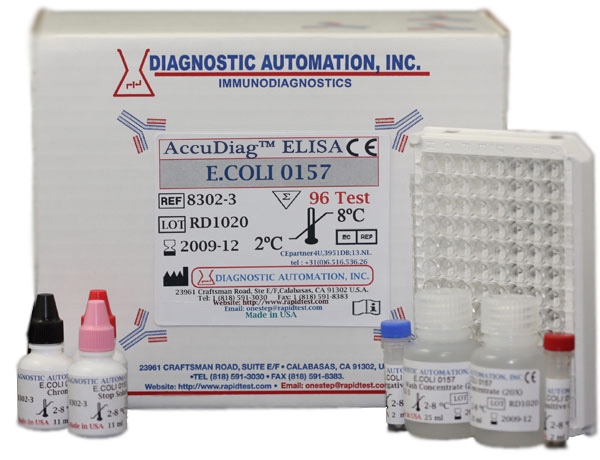
E.Coli O157 (Fecal) ELISA kit
| Name |
E.Coli O157 Fecal ELISA Test |
|---|---|
| Full name |
Human fecal E.Coli O157 ELISA Test Kit |
| Category Name | Parasitology ELISA kits |
| Test | 96 |
| Method | ELISA method: Enzyme Linked Immunosorbent Assay |
| Principle | ELISA principle- Sandwhich; Antibody Coated Plate |
| Detection Range | Qualitative elisa assay- Positive, Negative Controls |
| Sample | 1gm Stool Sample |
| Specificity | 100% |
| Sensitivity | 92% |
| Total Time | ~50min |
| Shelf Life | 12 months |
 |
 |
 |




E.Coli O157 (Fecal) ELISA kit description:

Diagnostic Automation Inc. E. coli O157 ELISA test kit is an in vitro procedure for the qualitative determination of Escherichia coli O157 antigen in feces. This ELISA kit is designed as a screening tool to allow rapid presumptive determination of the presence of E. coli O157 bacteria without prior culturing of the stool specimen.
Materials Provided with E. coli O157 ELISA kit:
1. Microwells coated with rabbit anti-E. coli O157polyclonal
2. E. coli O157 EIA Enzyme Conjugate goat anti-E.coli O157
3. E. coli O157 EIA Positive Control
4. E. coli O157 EIA Negative Control
5. Chromogen, TMB and peroxide
6. Wash Concentrate (20X)
7. Stop Solution
Materials Required, Not Provided:
1. Precision pipettes
2. Reagent grade DI water
3. EIA kit Microplate Washer
4. EIA kit Microplate Reader with a 450 & 620-650 nm filters
E. coli ELISA kit Background information:
E. coli O157, predominately O157:H7, has been implicated as the causative organism of hemolytic uremic syndrome (HUS) and hemorrhagic colitis (HC). HUS syndrome is characterized by microangiopathic hemolytic anemia, thrombocytopenia and renal failure while HC typically presents with abdominal cramps and watery diarrhea followed by a hemorrhagic discharge resembling lower gastrointestinal bleeding. Typically diagnosis has been done by culturing on sorbitol-MacConkey medium and then using typing antiserum. However, current latex assays and some typing antiserum have shown cross reactions with non-E. coli O157 colonies. Furthermore, not all E. coli O157 strains associated with HUS are nonsorbitol fermentors. Both syndromes have been associated with E. coli O157 and O157:H7 but are not limited to these organisms. These syndromes appear to be more closely linked to any organism that produces Shiga-like toxins. The E. coli O157 outbreaks are believed to be passed by the fecal oral route and has been isolated in an increasing number of food related poisonings involving undercooked beef and dairy products.
The Council of State and Territorial Epidemiologists recommend that clinical laboratories screen at least all bloody stools for this pathogen. The American Gastroenterological Association Foundation (AGAF) recommended in July 1994 that all stool specimens should be routinely tested for E. coli O157:H7.
E. coli ELISA Test Principle:
This assay is a double antibody (sandwich) ELISA using an anti-E.coli O157 antibody to capture the antigen from the stool supernatant. A second antibody, conjugated to HRP, is then added which binds to the complex. This reaction is visualized by the addition of the chromogen TMB. The resulting blue color development indicates the presence of E. coli O157 antigens being bound by the anti-E. coli O157 antibodies.
Notable features of the Parasitology ELISA Kits:
User-friendly directions and explanation of test procedures
Simple and safe reagent preparation
Clear instructions on specimen collection
Comprehensive package of required materials
Explicit quality control and storage guidelines
Reliable and easy-to-read test results
Product inserts for most Parasitology ELISA kits follow a similar method. See the E. coli ELISA Kit product insert for details on preparation, procedures, quality control, and test result interpretation.
Related ELISA Kit:
E.coli Verotoxin Fecal ELISA kit (Verotoxin ELISA Kit)
The verotoxin (VT), or shiga-like toxin family is a group of closely related toxins produced by certain strains of E. coli including E.coliO157. These strains are a significant cause of human hemorrhagic colitic (HC) and hemolytic uremic syndrome (HUS).
http://www.rapidtest.com/index.php?i=E.Coli-Verotoxin-(Fecal)-ELISA-kit&id=188&cat=17
Diagnostic Automation Inc. also provides other Parasitology ELISA Kits. For more information about ELISA Kits or Rapid Tests, IFA Kits, CLIA Test Kits, or Serology tests, please see our website home page, or contact our Customer Service Representative at 818-591-3030 .
Product Note:
All positive samples from this E. coli ELISA Test should then be cultured and serotyped to confirm the presence of O157 and its H antigen type.


.jpg "Campylobacter ELISA kit (Fecal)")