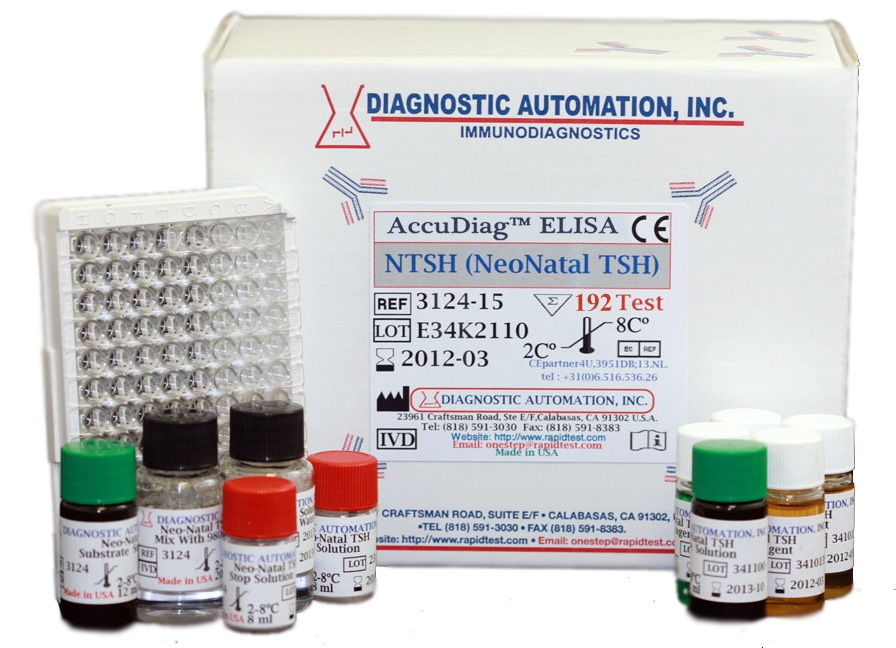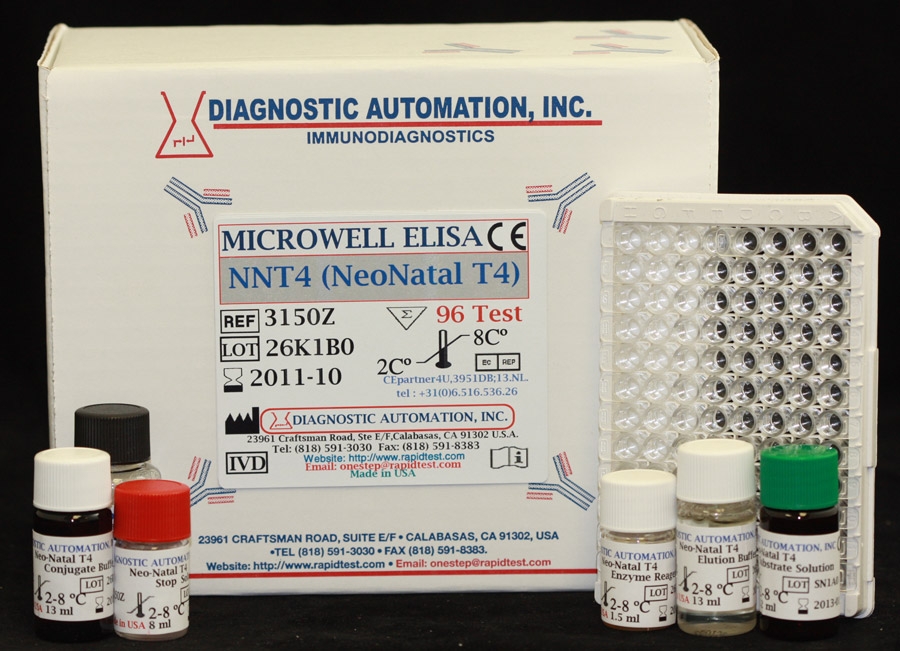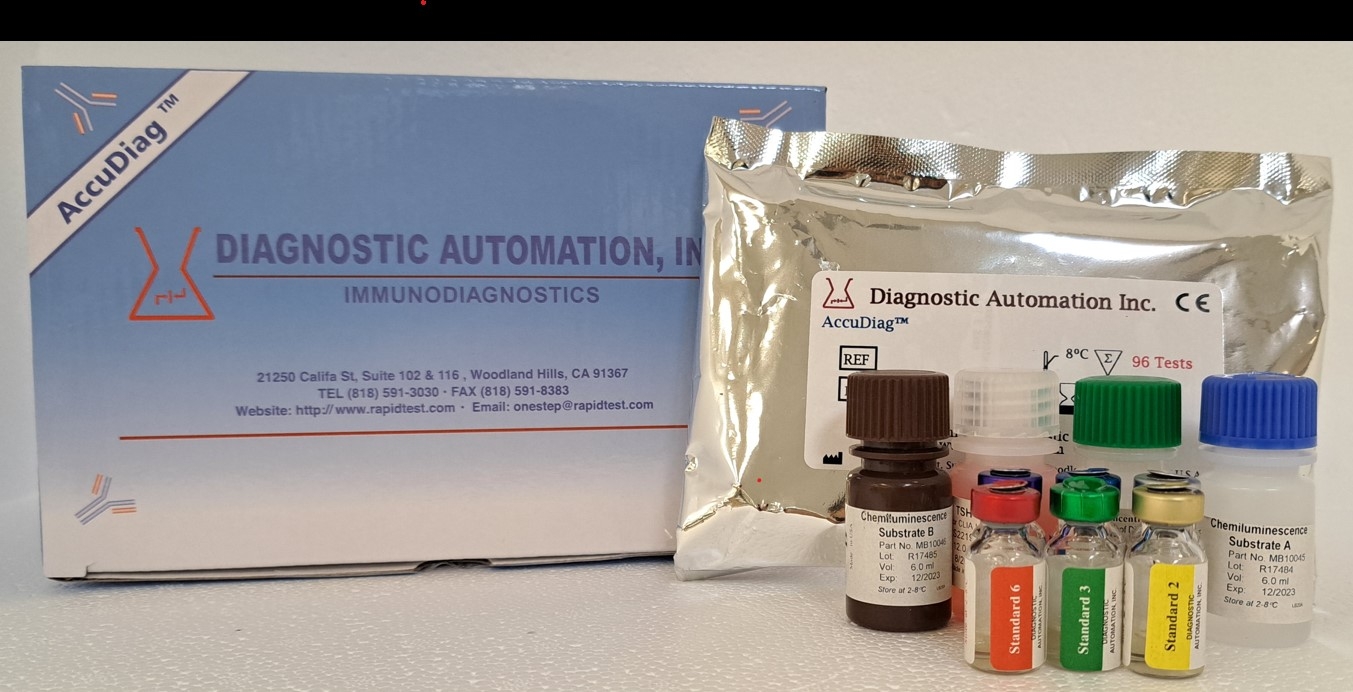








Free T3 ELISA kit
| Name |
Free T3 ELISA Test |
|---|---|
| Full name |
Human Free T3 ELISA Test Kit |
| Category Name | Thyroid ELISA kits |
| Test | 96 |
| Method | ELISA: Enzyme Linked Immunosorbent Assay |
| Principle | Competitive ELISA |
| Detection Range | 0-16pg/mL |
| Sample | 50uL |
| Specificity | 97% |
| Sensitivity | 0.05pg/mL |
| Total Time | ~75min |
| Shelf Life | 12-14 Months from the manufacturing date |
 |
 |
 |




Free T3 ELISA kit description:

The Diagnostic Automation Inc. free T3 ELISA kit test is an Enzyme Linked Immunosorbent Assay which can be used to determine the levels of Free T3 in human serum samples.
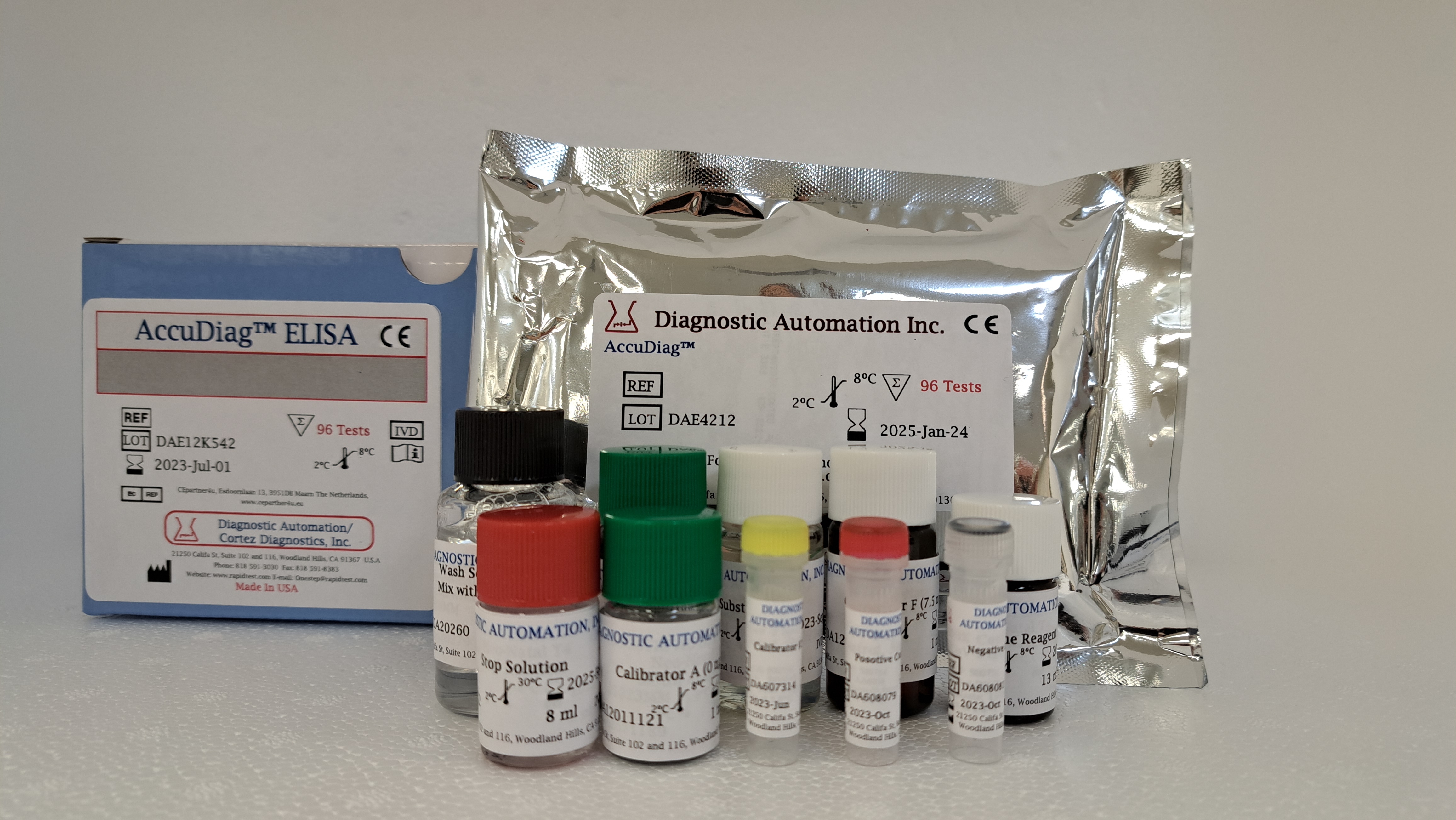
Materials provided with Free T3 ELISA Test Kit:
1. Free T3 Elisa Test Antibody Coated Microplate
2. Free T3 EIA Kit Enzyme HRP-Conjugate Reagent
3. Human Serum References for Free T3 EIA Test
0, 1.0, 3.0, 5.0, 8.0 &16.0 pg/ml
4. Wash Solution
5. Free T3 EIA Test Substrate A
6. Free T3 EIA Test Substrate B
7. Free T3 Test Kit Stop Solution
8. Product Instructions
Materials & Instrumentations required, not included:
1. Precision pipette
2. Quality control materials
3. EIA Microplate Washer
4. EIA Microplate Reader at 450nm & 620nm wavelength
Free T3 ELISA Test Kit Background Information
Triiodothyronine (T3), a thyroid hormone, circulates in blood almost completely bound (>99.5%) to carrier proteins. The main transport protein is thyroxine-binding globulin (TBG). However, only the free (unbound) portion of T3 is believed to be responsible for the biological action. Further, the concentrations of the carrier proteins are altered in many clinical conditions, such as pregnancy. In normal thyroid function as the concentrations of the carrier proteins alters, the total T3 level changes so that the free T3 concentration remains constant. Thus, measurements of free T3 concentrations correlate more reliably with clinical status than total T3 levels. For example, the increase in total T3 levels associated with pregnancy, oral contraceptives and estrogen therapy result in higher total T3 levels while the free T3 concentration remains basically unchanged.
Free T3 ELISA Test Principle
This microplate enzyme immunoassay methodology provides optimum sensitivity while requiring few technical manipulations in a direct determination of free T3. In this method, serum reference, patient specimen, or control is first added to a microplate well. Enzyme-T3 conjugate (analog method) is added, and then the reactants are mixed. A competition reaction results between the enzyme conjugate and the free T3 for a limited number of antibody combining sites immobilized on the well. After the completion of the required incubation period, the antibody bound enzyme- T3 conjugate is separated from the unbound enzyme-triiodothyronine conjugate by aspiration or decantation. The activity of the enzyme present on the surface of the well is quantitated by reaction with a suitable substrate to produce color. The employment of several serum references of known free T3 concentration permits construction of a graph of activity and concentration. From comparison to the dose response curve, an unknown specimen's activity can be correlated with free T3 concentration.
Diagnostic Automation Inc. also provides other Thyroid ELISA kits. For more information about these ELISA Kits or Rapid Tests, IFA Kits, CLIA Test Kits, or Serology tests, please see our website home page, or contact our Customer Service Representative at 818-591-3030.
Product Note:
FT3 ELISA kit applies the competitive enzyme immunoassay technique utilizing a monoclonal anti-FT3 antibody and an FT3-HRP conjugate. The assay sample and buffer are incubated together with FT3-HRP conjugate in pre-coated plate for one hour. After the incubation period, the wells are decanted and washed five times. The wells are then incubated with a substrate for HRP enzyme. The product of the enzyme-substrate reaction forms a blue colored complex. Finally, a stop solution is added to stop the reaction, which will then turn the solution yellow. The intensity of color is measured spectrophotometrically at 450nm in a microplate reader. The intensity of the color is inversely proportional to the FT3 concentration since FT3 from samples and FT3-HRP conjugate compete for the anti-FT3 antibody binding site. Since the number of sites is limited, as more sites are occupied by FT3 from the sample, fewer sites are left to bind FT3-HRP conjugate. A standard curve is plotted relating the intensity of the color (O.D.) to the concentration of standards. The FT3 concentration in each sample is interpolated from this standard curve.